
Last Updated on April 24, 2026 by Kari-Ann Ryan
Yes, movers are liable for lost or damaged items, but the amount they owe depends on the type of coverage you select. Moving to a new home is an exciting milestone, but it comes with important decisions including choosing the right residential moving company. While you are busy planning and packing, it is easy to overlook what happens if something goes missing or gets damaged along the way. Understanding moving company liability is essential for protecting your belongings and ensuring fair compensation if problems arise.
This guide covers everything homeowners need to know, from federal and state regulations to filing a claim and choosing a trustworthy mover in the Chicago and Elk Grove Village, Illinois area.
Legal Responsibility of Moving Companies for Lost Items
Licensed residential moving companies are legally required to be liable for the loss or damage of goods they transport. However, the compensation amount depends on whether the move is interstate or intrastate, which coverage option the homeowner selects, and the regulations of the applicable state.
Interstate Moves: The Carmack Amendment
For moves that cross state lines, the Carmack Amendment is the federal law that governs mover liability. It requires interstate movers to be liable for the full loss or damage of transported goods. If you are planning a long-distance move across state lines, the compensation you can recover depends on the valuation option selected in the moving contract. Homeowners who do not specify a coverage level are automatically placed on the most basic plan, which provides minimal reimbursement.
Intrastate Moves: State Regulations Apply
For moves within the same state, individual state regulations govern mover liability, and these vary significantly. In Illinois, the default liability coverage is $0.60 per pound per article of lost goods. To put that in perspective, a 50-pound television worth $800 would yield only a $30 reimbursement under the basic plan. Higher coverage options are available and strongly recommended for any move involving items of meaningful value.
Local Movers vs Major Moving Companies
Local movers operate within a 100-mile radius and are licensed by their state Department of Transportation. Major moving companies handle long-distance and cross-country relocations, are registered with the federal USDOT, and are better suited for large-volume moves. Both are legally required to offer at least basic liability coverage to customers.
Moving Company Insurance: Released Value vs Full Value Protection vs Third-Party
There are three main types of moving coverage, and the one you choose directly determines how much compensation you can receive if items are lost or damaged. Understanding the differences before signing any contract is one of the most important steps a homeowner can take before moving day.
| Coverage Type | Cost | What It Covers | Best For |
|---|---|---|---|
| Released Value Protection | Free (included) | $0.60 per pound per item | Low-value, non-fragile items |
| Full Value Protection | Additional fee (varies) | Repair, replace, or reimburse current market value | Most moves, especially valuables |
| Third-Party Moving Insurance | Separate premium | Fills gaps not covered by mover policies | Antiques, fine art, high-value electronics |
Released Value Protection
Released Value Protection is the most basic coverage option and is included at no additional cost, but it offers very limited reimbursement. Compensation is calculated at $0.60 per pound per item, not based on the item’s actual value. A 30-pound laptop worth $1,500 would receive just $18 under this plan. It is suitable only for moves involving low-value or non-fragile items where financial loss would be minimal.
Full Value Protection
Full Value Protection is the most comprehensive option offered directly by the moving company. Under this plan, the mover is responsible for repairing the damaged item, replacing it with one of equivalent value, or reimbursing you for its current market value. While it comes at an additional cost, it provides far greater financial security and is the right choice for most residential moves.
Third-Party Moving Insurance
Third-party moving insurance is the best option for high-value, rare, or irreplaceable items such as antiques, fine art, or specialty electronics. These policies fill coverage gaps that standard mover options may not address and often provide the most comprehensive reimbursement. The added expense is well worth it when transporting belongings that hold significant financial or sentimental value.
What to Do If Movers Lose or Damage Your Belongings
If movers lose or damage your items, the most important first step is to notify the moving company in writing as soon as possible and begin gathering documentation for your claim. Most companies have a defined claims process, and acting quickly improves your chances of a favorable outcome significantly.
Step 1: Notify the Moving Company Immediately
Contact the moving company as soon as you discover the loss or damage. Many movers require claims to be submitted within a specific window after delivery, sometimes as short as 30 to 60 days. Missing this deadline can result in a denied claim regardless of how valid the loss is.
Step 2: Complete the Official Claim Form
Request and complete the mover’s official claim form with as much detail as possible. You can also submit your claim directly via our online claim form. Include a description of each lost or damaged item, its estimated value, and its condition before the move. Vague or incomplete forms are a common reason claims are delayed or denied
Step 3: Gather Supporting Documentation
Strong documentation is the most critical factor in a successful moving claim. Prepare the following before submitting your claim:
- A copy of your inventory list or bill of lading
- Receipts or proof of purchase for damaged or missing items
- Photos showing the condition of items before and after the move
- All written correspondence with the moving company
Step 4: Follow Up and Track Your Claim
After submission, expect the moving company to review the claim and potentially request additional information or conduct an inspection. Processing timelines vary but most claims are resolved within several weeks to a few months. Keep thorough records of every communication throughout the process in case escalation becomes necessary.
Tips to Prevent Loss or Damage During Your Move
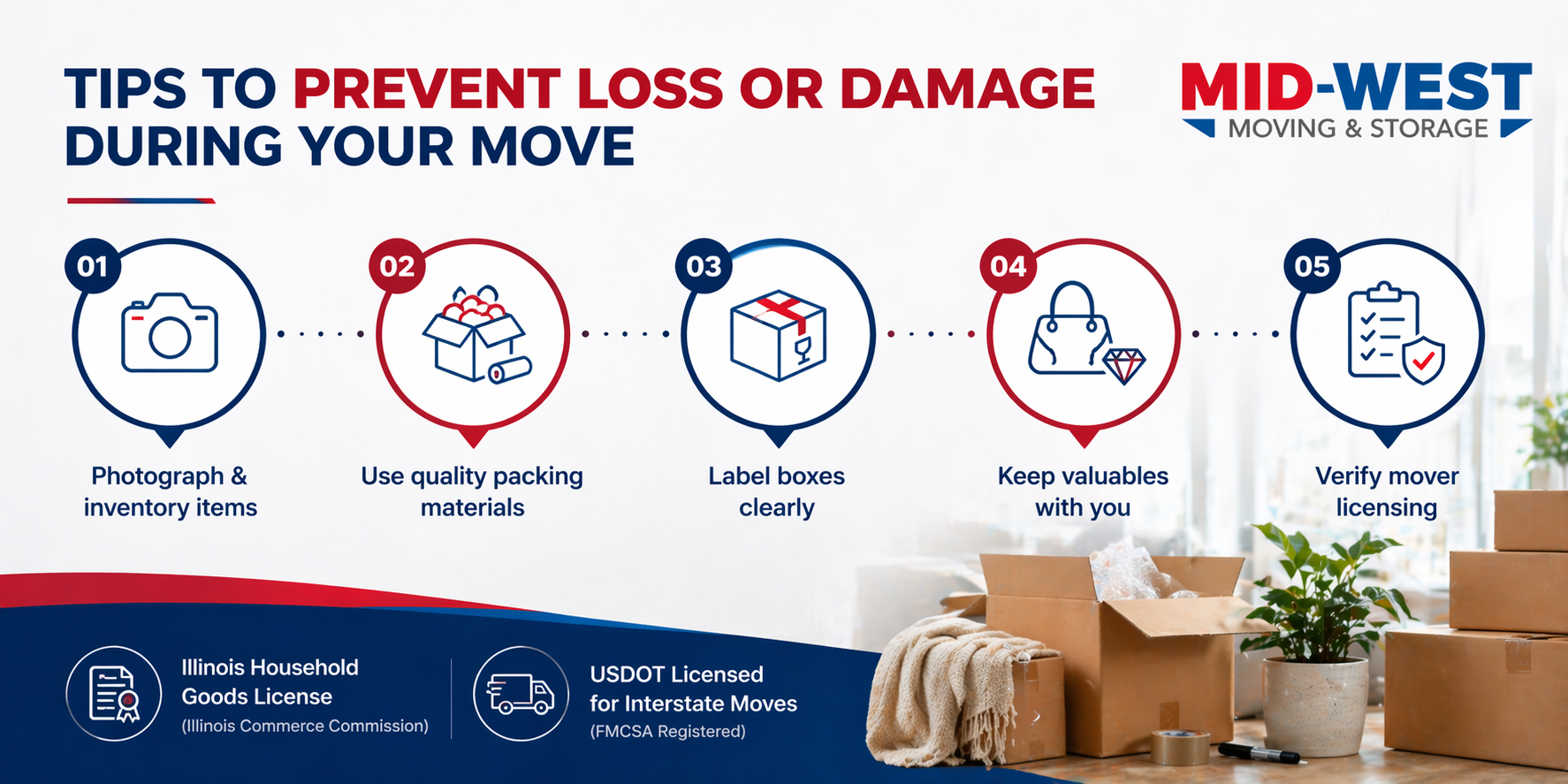
The most effective way to avoid a claim is to take preventive steps before moving day. These practical measures significantly reduce the risk of loss or damage to your belongings:
- Photograph all belongings before packing and record their condition on a detailed inventory list
- Use new, sturdy boxes with generous bubble wrap and specialty containers for fragile and high-value goods
- Label every box clearly, including fragile markings where appropriate
- Keep irreplaceable or extremely high-value items in your personal possession during the move rather than loading them onto the truck
- Verify that your mover holds the proper state or federal licensure before signing any contract
In Illinois, moving companies are required by state law to hold a Household Goods License from the Illinois Commerce Commission. Interstate movers must be licensed by the Federal Motor Carrier Safety Administration and carry a USDOT number. Confirming these credentials before hiring protects you from unregistered or rogue operators
Critical Mistakes to Avoid When Moving
Most homeowners only discover these mistakes after something goes wrong. Avoiding them from the start protects both your belongings and your ability to file a successful claim:
- Skipping Full Value Protection: Released Value Protection reimburses almost nothing relative to the actual value of most items. Always consider upgrading before signing the contract.
- Not reading the contract: Hidden fees, claim deadlines, and liability limits are buried in moving contracts. Review every clause carefully before signing.
- Failing to document belongings: Without an inventory list, photographs, and receipts, proving the value of a lost or damaged item becomes extremely difficult.
- Ignoring professional packing liability: If the mover packs your items and damage occurs, confirm in writing how liability is handled so there are no disputes later.
- Hiring an unlicensed mover: Unregistered companies have no legal accountability. Always verify license numbers through the FMCSA or your state DOT before committing
How to Choose a Licensed and Trustworthy Moving Company
The single most effective way to protect your belongings is to hire a licensed, insured, and well-reviewed moving company before agreeing to any terms. Use these steps to properly vet any mover before committing:
- Visit the FMCSA website at fmcsa.dot.gov to verify a mover’s registration status, insurance levels, and complaint history
- Request written documentation of the mover’s Full Value Protection and Released Value Protection options before signing
- Ask directly: What is your default liability coverage? and How do you handle high-value or fragile items?
- Confirm the mover is bonded, which provides a path to compensation if the company fails to fulfill its contractual obligations
- Check online reviews across multiple platforms and look for consistent patterns in how the company resolves disputes and handles claims
Mid-West Moving and Storage is a licensed, insured, and background-checked residential moving company serving customers locally, long-distance, and internationally from our Chicago and Elk Grove Village, Illinois locations. Our vetted crews offer comprehensive services including packing, unpacking, and both short-term and long-term storage solutions. Whether you are relocating within the Chicago metro area or across the country, our team delivers a seamless, secure, and affordable relocation experience. Contact our office today to request a free moving quote.
Mover Liability FAQs
Do movers cover lost items?
Are moving companies responsible for missing items?
How much liability does a moving company have?
Is moving insurance worth it?
What should I do if my items are lost or damaged?
Do movers insure furniture and electronics?
What happens if the moving company loses your stuff entirely?

Director of Marketing & Development
Kari-Ann Ryan is a dynamic marketing strategist with a proven track record in brand development, corporate visibility, and business growth. As the Director of Marketing & Development for Mid-West Moving & Storage and Chicago Office Movers, she leads all branding, marketing, and business development initiatives, driving awareness and engagement across multiple industries.
With extensive experience in multi-brand marketing, nonprofit fundraising, event planning, and retail management, Kari-Ann brings a comprehensive and results-driven approach to her role. She is a dedicated leader in the business community, actively involved in the Schaumburg Business Association and the GOA Regional Business Association. She also serves as a Board Member for the Alzheimer’s Association Illinois Chapter, reinforcing her commitment to advocacy and philanthropy.
In addition to her corporate role, Kari-Ann is the founder of LMJ’s Lost Souls – Alzheimer’s Fund, a nonprofit organization dedicated to awareness, education, and fundraising for Alzheimer’s research and support.
She holds a Bachelor of Business Administration in Marketing from Western Michigan University and is Certified in Constant Contact Email Marketing, with expertise in social media strategy and digital engagement.