
Last Updated on September 15, 2026 by Kari-Ann Ryan
If you’re thinking about moving in 2026, the question is not simply which states are growing fastest. The better question is: Where can you still afford a home, find a good job, keep more of your income, and enjoy a high quality of life?
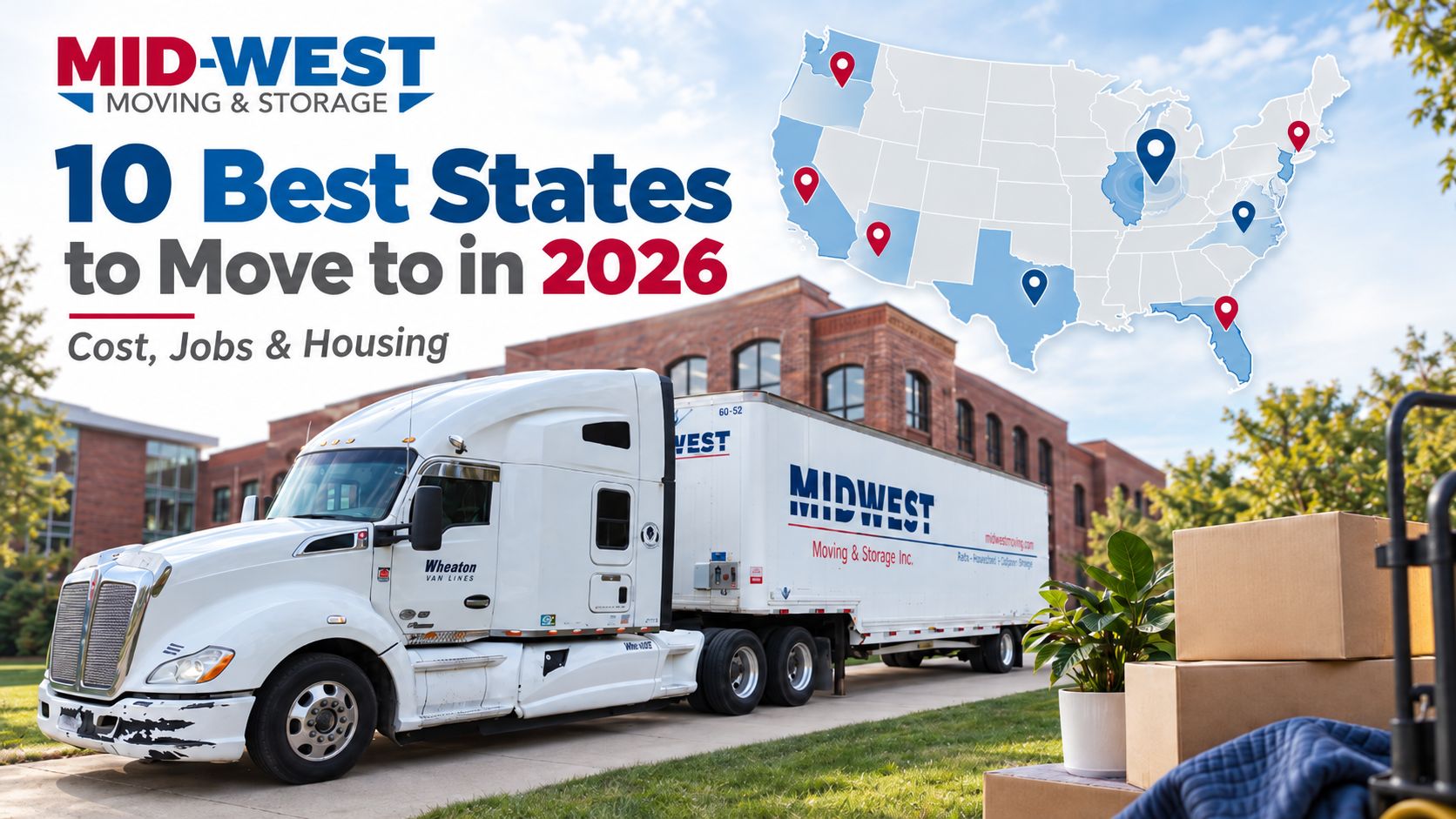
Based on those factors, our 10 best states to move to in 2026 are South Carolina, Idaho, North Carolina, Florida, Tennessee, Texas, Arizona, Alabama, South Dakota, and Virginia. Each offers a different combination of housing affordability, employment opportunities, taxes, safety, health, and overall quality of life, and several continue to attract people leaving higher-cost states such as Illinois.
We built these rankings using cost-of-living indexes, home values, employment data, tax rates, safety and health measures, and actual moving demand. We also weighted those factors based on what matters most to people making a long-distance move. We explain the methodology and sources later in the article, so you can see exactly how each state earned its place on the list.
| Rank | State | Best For |
|---|---|---|
| 1 | South Carolina | Overall relocation value |
| 2 | Idaho | Quality of life and safety |
| 3 | North Carolina | Jobs plus affordability |
| 4 | Florida | Warm weather, no income tax, retirees |
| 5 | Tennessee | Low taxes and affordability |
| 6 | Texas | Job growth and business relocation |
| 7 | Arizona | Sun Belt metros and semiconductor jobs |
| 8 | Alabama | Lowest housing costs among growth states |
| 9 | South Dakota | Taxes, safety, smaller-city living |
| 10 | Virginia | Careers, schools and healthcare |
How We Chose the Best States to Move to in 2026
Most “best states” lists copy each other. We wanted a ranking built from data a reader can verify, so we scored all 50 states across seven categories and weighted them by what drives relocation decisions.
| Factor | Weight | What We Measured |
|---|---|---|
| Affordability | 25% | MERIC cost-of-living index, grocery and utility costs, state income and property taxes |
| Jobs and Economy | 20% | Employment growth, industry diversity, median household income, major employers |
| Housing | 15% | Typical home value, price-to-income ratio, rent levels, inventory |
| Quality of Life | 15% | Commute times, outdoor access, climate, WalletHub quality-of-life scoring |
| Safety | 10% | Violent and property crime rates |
| Healthcare and Education | 10% | Hospital quality, insured rates, school performance and attainment |
| Migration Demand | 5% | moveBuddha in-to-out search ratios, United Van Lines inbound share, Census population change |
Two notes on method. First, we treat migration demand as a small input rather than the whole answer, because popularity and livability are not the same thing. Second, we penalized states where a headline benefit hides a cost somewhere else such as a state with no income tax but punishing property taxes or insurance premiums.
Where are Americans Moving in 2026?
Interest and actual moves tell slightly different stories, and both are useful when evaluating where people are heading.
MoveBuddha analyzed 78,000 searches through its moving cost calculator in the first quarter of 2026. Idaho led the country with 2.05 searches for moves in for every search for a move out, the state’s first reading above 2.0 since 2020. South Carolina followed at 2.01, North Carolina at 1.63, and Tennessee at 1.46. By raw volume rather than ratio, Florida captured 26% of all net inbound search demand, followed by North Carolina at 16.2%, Texas at 13.1%, South Carolina at 10.1%, and Arizona at 6.9%. Together, those five states accounted for roughly 70% of net inbound demand.
The Mountain West was the year’s surprise. Montana posted the largest year-over-year gain in its in-to-out ratio at 42 percentage points, followed by Idaho, Arizona, and New Mexico. Only 19 of the 50 states gained ground year over year.
Completed moves tell a somewhat different story. United Van Lines’ 49th Annual National Movers Study, based on 2025 household shipments, ranked Oregon first at 64.5% inbound, followed by West Virginia (62.1%), South Carolina (60.8%), Delaware (59.7%), and Minnesota (58.2%). Idaho, North Carolina, Arkansas, Alabama, and Nevada rounded out the top ten. The study also found something Illinois residents should note: for the first time in more than a decade, Texas and Florida recorded roughly balanced inbound and outbound moves, while Illinois dropped off the top outbound list entirely.
Are the best states to live in the same as the most popular states to move to?
No, and the gap between those two lists may be the most useful takeaway on this page.
WalletHub’s 2026 ranking scored all 50 states across 51 metrics covering affordability, economy, education and health, quality of life, and safety. Idaho took the top spot with a score of 60.15, helped by the nation’s strongest median income growth and third-lowest crime rate. New Jersey ranked second, followed by Wisconsin, Massachusetts, and New Hampshire. Florida was the only Sun Belt state to crack the top ten.
Now compare that list with the migration data above. New Jersey ranks second nationally for livability but near the bottom for affordability, helping explain why it has topped United Van Lines’ outbound list for eight consecutive years. Massachusetts ranks fourth for livability while carrying the nation’s second-highest cost of living, at 147.8 on the MERIC index. Meanwhile, Oklahoma, the country’s most affordable state, does not appear on major “best places to live” rankings.
People are not necessarily moving to the highest-scoring states. They are moving to places where the balance between what they earn, what they pay, and what they get in return still makes sense.
The 10 Best States to Move to in 2026
1. South Carolina
- Best for: Families, retirees and anyone trading Midwest winters for warm-weather affordability
- Why people are moving here: South Carolina has topped or nearly topped inbound migration rankings for four consecutive years. United Van Lines recorded 60.8% of its South Carolina shipments as inbound in 2025, third in the country, and the state has appeared on that top-inbound list six years running.
- Cost of living: MERIC puts South Carolina at 92.7 against a national baseline of 100, with housing costs around 80% of the national figure. Typical home value sits near $307,000, roughly $15,000 above Illinois, though Charleston and Hilton Head run far higher than the state median suggests.
- Job market: Manufacturing anchors the economy: BMW in Spartanburg, Boeing in North Charleston, Volvo outside Ridgeville. The Port of Charleston supports logistics employment statewide, and healthcare and tourism fill in the rest. Wages trail the national median, which is the trade-off for the lower cost base.
- Housing: Inventory is better than most Sun Belt markets, and builders have kept pace in the Upstate and Midlands. Coastal counties are tighter and more expensive.
- Best cities to consider: Charleston, Greenville, Columbia, Myrtle Beach, Rock Hill
- Pros: Low property taxes on owner-occupied homes; mild winters; strong manufacturing base; four-hour drive to both mountains and beaches
- Cons: Homeowners insurance on the coast is expensive and getting more so; rural healthcare access is uneven; road quality is a common complaint; hurricane exposure below the fall line
- Bottom line: South Carolina wins because nothing about it is extreme. It is not the cheapest state, the safest state or the highest-paying state, but it lands in the upper half on nearly every measure that matters, which is why it keeps drawing more arrivals than departures.
2. Idaho
- Best for: Outdoor recreation, safety and families willing to pay for quality of life
- Why people are moving here: Idaho was WalletHub’s best state to live in for 2026 and moveBuddha’s most-searched destination in early 2026. Census data showed 80% of Idaho counties grew in 2025. About 24% of searched moves into Idaho this year originated in California.
- Cost of living: MERIC scores Idaho at 99.3, essentially at the national average. That number surprises people who assume the Mountain West is cheap.
- Job market: Micron’s semiconductor operations in Boise drive the technical side, with healthcare, construction and agriculture filling out employment. Idaho recorded the strongest median income growth in the country, which is the single best argument for moving there.
- Housing: This is the weak point. Typical home value is around $465,000, about 60% higher than Illinois, and the price-to-income ratio is among the steepest in the country. Boise-area inventory has improved, but affordability has not caught up to wage growth.
- Best cities to consider: Boise, Meridian, Coeur d’Alene, Idaho Falls, Nampa
- Pros: Third-lowest crime rate nationally; short commutes; immediate access to mountains, rivers and public land; low property tax burden
- Cons: Housing costs well above what local wages support; real winters; limited big-city amenities outside Boise; long-time residents are vocal about growth pressure
- Bottom line: Idaho is the best-scoring state in the country to live in and one of the harder ones to afford. If you are selling a Chicago-area home with equity, the math works. If you are moving for a first job, run the numbers twice.
3. North Carolina
- Best for: Career moves, young professionals and families who want jobs without coastal pricing
- Why people are moving here: North Carolina absorbs 16.2% of all net inbound move searches, second only to Florida, and United Van Lines logged 57.8% of its North Carolina shipments as inbound in 2025 across 7,538 tracked moves, one of the largest sample sizes in the study.
- Cost of living: MERIC puts the state at 97.9, just below the national average. Housing is close to par at 94.
- Job market: The Research Triangle carries pharmaceuticals, biotech and software. Charlotte is the second-largest banking center in the United States. Advanced manufacturing and electric-vehicle supply-chain investment have spread into the Piedmont. This is the most diversified economy on our list outside Texas and Virginia.
- Housing: Typical home value runs about $339,000. Raleigh, Durham and Charlotte have climbed steadily; Winston-Salem, Greensboro and Fayetteville remain considerably cheaper.
- Best cities to consider: Raleigh, Durham, Charlotte, Wilmington, Asheville, Winston-Salem
- Pros: Deep and varied job market; well-regarded public universities; mountains and coast in the same state; moderate income tax
- Cons: Metro home prices have outpaced the state average; traffic in the Triangle and Charlotte; hurricane and inland flooding risk; western mountain communities are still rebuilding from recent storm damage
- Bottom line: If you are moving for work rather than weather, North Carolina gives you the most options. It is the state on this list where a mid-career professional is least likely to take a pay cut.
4. Florida
- Best for: Retirees, remote workers and anyone prioritizing climate and no state income tax
- Why people are moving here: Florida draws more raw inbound demand than any other state at 26% of net inbound searches, and it was the only Sun Belt state in WalletHub’s 2026 top ten. It is also the destination we move the most Illinois households to.
- Cost of living: MERIC puts Florida at 101.4, slightly above the national average. No state income tax is the headline, but it is not the whole bill.
- Job market: Healthcare, hospitality, logistics, construction, aerospace along the Space Coast, and a growing finance presence in Miami and Tampa. Seasonal and service employment remains a large share of the market outside the major metros.
- Housing: Typical home value is roughly $405,000, and Florida is one of the few states where values have softened year over year. Inventory has recovered sharply, which gives buyers leverage they did not have three years ago.
- Best cities to consider: Tampa, Jacksonville, Orlando, Sarasota, Ocala, The Villages
- Pros: No state income tax; homestead exemption and Save Our Homes assessment cap for permanent residents; genuine buyer’s market conditions in several metros; no shortage of retirement infrastructure
- Cons: Homeowners insurance is the highest in the country and the single biggest budget surprise for arrivals; condo association assessments have risen steeply since structural reserve requirements took effect; summer heat and humidity; hurricane exposure statewide
- Bottom line: Florida still works, particularly for retirees and remote workers on fixed or portable income. Just build insurance into your budget before you shop for a house, not after.
5. Tennessee
- Best for: Remote workers, retirees and buyers who want no income tax without Florida’s insurance bills
- Why people are moving here: Tennessee has run consistently positive inbound interest, at 1.46 searches in for every search out in early 2026, and United Van Lines classified it as a high-inbound state at 56% in 2025.
- Cost of living: MERIC scores Tennessee at 90.1, about 10% below the national average, with housing near 82. It is the most affordable no-income-tax state on this list.
- Job market: Healthcare administration is concentrated in Nashville. Automotive manufacturing runs across the state, with Nissan in Smyrna, Volkswagen in Chattanooga and Ford’s BlueOval City complex in West Tennessee. FedEx’s global hub anchors Memphis logistics.
- Housing: Typical home value is around $336,000 statewide, but Nashville has decoupled from the rest of Tennessee. Knoxville, Chattanooga and the Tri-Cities are considerably cheaper and are where most of the growth is heading.
- Best cities to consider: Knoxville, Chattanooga, Nashville, Johnson City, Murfreesboro
- Pros: No state income tax on wages; below-average cost of living; central location with strong highway access; no shortage of outdoor recreation in the eastern half
- Cons: Combined state and local sales tax is among the highest in the country, which offsets part of the income-tax savings; Nashville housing has priced out many locals; tornado risk; rural healthcare gaps
- Bottom line: Tennessee delivers the tax benefit people move to Florida for, at a lower cost of living and without coastal insurance. Knoxville in particular is forecast to lead the country in inbound interest for 2026.
6. Texas
- Best for: Job seekers, business owners, and large families who need square footage
- Why people are moving here: Texas takes 13.1% of net inbound move searches and ranks first in U-Haul’s truck-rental growth index. Notably, United Van Lines classified Texas as “balanced” rather than high-inbound in 2025 at 50.7%, a real shift from its long run as the country’s biggest magnet.
- Cost of living: MERIC scores Texas at 91.1, with housing at 79.4. Typical home value is about $308,000, roughly $16,000 above Illinois.
- Job market: The broadest in the country. Energy, technology, healthcare, logistics, defense and corporate headquarters relocations. Texas adds jobs across wage bands rather than concentrating growth at the top.
- Housing: Builders in Dallas-Fort Worth, Houston, and San Antonio have produced enough inventory to flatten prices while much of the country kept climbing. That is rare and worth taking advantage of.
- Best cities to consider: Dallas-Fort Worth, Houston, San Antonio, Fort Worth suburbs, Austin
- Pros: No state income tax; strongest job creation in the country; genuinely affordable new construction; major airports for getting back to Chicago
- Cons: Property tax rates are among the highest in the nation and erase much of the income-tax savings for homeowners; rising homeowners and windstorm insurance; long commutes; summer heat and utility bills
- Bottom line: Texas remains the best state on this list for pure employment opportunity. Ask for the property tax bill on any house you tour, not the asking price alone, the annual number often surprises Illinois buyers in the wrong direction, even coming from Cook County.
7. Arizona
- Best for: Sun Belt living, semiconductor and aerospace careers, and retirees who prefer dry heat
- Why people are moving here: Arizona takes 6.9% of net inbound search volume and posted one of the largest year-over-year gains in inbound interest, up 27 points. United Van Lines recorded 56.5% inbound across 4,432 tracked moves in 2025.
- Cost of living: This is where Arizona gets complicated. MERIC scores the state at 110.3, above the national average, with housing at 127.3. Arizona is not a cheap state anymore.
- Job market: TSMC’s Phoenix semiconductor investment has pulled a supplier ecosystem with it. Add established aerospace and defense employers, a large healthcare sector, and the tourism economy in Scottsdale, Sedona, and Tucson.
- Housing: Typical home value is around $440,000. Phoenix-area inventory has loosened substantially, and price growth has flattened, so buyers have more room to negotiate than at any point since 2020.
- Best cities to consider: Gilbert, Chandler, Peoria, Tucson, Prescott, Flagstaff
- Pros: Flat 2.5% state income tax, the lowest flat rate in the country; no snow removal, ever; strong high-tech employment growth; excellent air connections to Chicago
- Cons: Cost of living above the national average despite the low income tax; summer electric bills that run several hundred dollars; long-term Colorado River water allocation questions; extreme summer heat is a genuine health consideration for older movers
- Bottom line: Arizona sells lifestyle and increasingly backs it with real careers. Go in knowing the state is no longer the bargain it was a decade ago, and budget for cooling costs the way you currently budget for heating.
8. Alabama
- Best for: Buyers who want the lowest possible housing cost without leaving a growing economy
- Why people are moving here: Alabama logged 57.1% inbound moves with United Van Lines in 2025 and has been on that top-inbound list for six consecutive years. It is the quietest state on this list and one of the best values.
- Cost of living: MERIC ranks Alabama second-cheapest in the country in its most recent quarterly data at 85.0, with housing costs under 70% of the national figure.
- Job market: Huntsville is the surprise: Redstone Arsenal, NASA’s Marshall Space Flight Center and a dense defense and aerospace contractor base give it one of the highest concentrations of engineers in the country. Automotive assembly plants operate across the state, along with steel and shipbuilding in Mobile.
- Housing: Typical home value is roughly $232,000, about $60,000 below Illinois and less than half of Idaho. For a household leaving the Chicago suburbs, this is the biggest equity swing on the list.
- Best cities to consider: Huntsville, Madison, Birmingham, Auburn, Mobile, Fairhope
- Pros: Lowest housing costs among fast-growing states; strong engineering and defense employment in the Huntsville area; low property taxes; mild winters
- Cons: Median wages are below the national average outside Huntsville; healthcare access is limited in rural counties; K-12 outcomes rank low nationally; tornado risk is real and requires a shelter plan
- Bottom line: Alabama is the value pick. Huntsville in particular gives you national-caliber technical employment at regional housing prices, which is an unusual combination in 2026.
9. South Dakota
- Best for: Tax-conscious movers, retirees and people who prefer smaller cities
- Why people are moving here: South Dakota draws steady inbound interest for a state of its size, largely on tax treatment and safety rather than climate.
- Cost of living: MERIC scores South Dakota at 91.8, roughly 8% below the national average. Typical home value is about $321,000, higher than you might expect because Sioux Falls has grown quickly.
- Job market: Healthcare dominates through the Sanford and Avera systems. Sioux Falls carries a long-established credit card and financial services operations sector. Agriculture and food processing round it out. The market is small, so verify a job before you move rather than after.
- Housing: Sioux Falls is competitive; Rapid City and the smaller cities are easier. Inventory statewide is limited simply because the market is thin.
- Best cities to consider: Sioux Falls, Rapid City, Brookings, Aberdeen
- Pros: No state income tax and no state inheritance tax; low crime; short commutes; genuinely low overall tax burden
- Cons: Winters are harsher than Illinois, not milder; small job market with limited specialization; fewer medical specialists outside Sioux Falls; limited direct flights
- Bottom line: South Dakota is for people moving toward something specific such as lower taxes, a quieter pace, or family nearby rather than away from Midwest weather. If winter is your reason for leaving Illinois, this is the wrong state.
10. Virginia
- Best for: Careers in government, defense and tech; families prioritizing schools and healthcare
- Why people are moving here: Virginia rarely tops migration lists, but it scores consistently well on the measures people say they care about once they arrive: schools, healthcare, safety and income.
- Cost of living: MERIC puts Virginia at 102.2, slightly above the national average, with wide internal variation. Northern Virginia is expensive; Roanoke and Southside are not.
- Job market: Federal employment and defense contracting, the country’s largest concentration of data centers in Loudoun County, shipbuilding in Newport News, and a growing technology sector in Richmond and Arlington. Median household income is well above the national figure.
- Housing: Typical home value is about $417,000 statewide, heavily skewed by the DC suburbs. Richmond, Hampton Roads and the Shenandoah Valley are considerably more attainable.
- Best cities to consider: Richmond, Virginia Beach, Chesapeake, Roanoke, Charlottesville
- Pros: Strong public schools and universities; above-average healthcare access; four distinct but mild seasons; high median incomes
- Cons: Cost of living above the national average; Northern Virginia housing and traffic are difficult; hurricane and coastal flooding exposure in Hampton Roads; state income tax tops out at 5.75%
- Bottom line: Virginia is the list’s quality play rather than its value play. You pay closer to national-average prices and get better schools, hospitals and wages in return.
Best States to Move to Based on Your Priorities
Best States for Families
North Carolina, Virginia, Minnesota, Wisconsin and New Hampshire. These states combine above-average school performance, healthcare access, and safety scores with housing that has not detached from local incomes. Virginia and Minnesota score highest on education and health; North Carolina offers the best combination of schools and job availability.
Best States for Young Professionals
Texas, North Carolina, Tennessee, Colorado and Virginia. What matters at this stage is the number of employers hiring, not the cost of a four-bedroom house. Dallas, Charlotte, Nashville, Raleigh and Richmond all offer entry- and mid-level openings across several industries, which matters if your first job there does not work out.
Best States for Retirees
Florida, Tennessee, South Carolina, Arizona and Alabama. WalletHub’s 2026 retirement ranking put Wyoming and Florida at the top, weighting affordability, quality of life, and healthcare. Tennessee and South Carolina deliver most of Florida’s tax advantages at lower housing and insurance costs. Check specialist physician availability in any rural area before committing.
Best Affordable States
Oklahoma, Alabama, Mississippi, Kansas and West Virginia. MERIC’s most recent quarterly data ranks Oklahoma cheapest in the country at 83.5, followed by Alabama at 85.0, Mississippi at 86.2, Kansas at 87.6, and West Virginia at 87.9. Housing drives most of the gap, Oklahoma’s housing index sits near 67 against a national 100.
Best States for Remote Workers
Tennessee, Texas, Florida, North Carolina and Arizona. The calculation for remote workers is different: you keep your income and change your cost base. That makes no-income-tax states with mid-range housing the strongest plays. Verify home internet service at a specific address, not just a city, rural fiber coverage varies block by block in all five.
Best States for Jobs
Texas, North Carolina, Florida, Virginia and Arizona. Texas leads on volume and industry diversity. North Carolina and Virginia offer the strongest professional and technical wage growth. Arizona’s semiconductor buildout has created a supplier ecosystem that did not exist five years ago. Alabama’s Huntsville metro deserves a mention well above its state ranking.
Best States for Low Taxes
Tennessee, Texas, Florida, South Dakota, Nevada, and Wyoming levy no state income tax on wages. However, Texas carries some of the highest effective property tax rates in the country. Florida has the most expensive homeowners insurance. Tennessee’s combined sales tax is among the nation’s highest. A no-income-tax state can still cost you more per year than Illinois once the full bill is assembled, which is why our ranking weights total affordability rather than income tax alone.
Cheapest States to Live in 2026
| Rank | State | Cost of Living Index | Housing Index | Best For |
|---|---|---|---|---|
| 1 | Oklahoma | 83.5 | 66.9 | Lowest overall costs |
| 2 | Alabama | 85.0 | 67.7 | Affordability plus job growth |
| 3 | Mississippi | 86.2 | 71.0 | Lowest home prices nationally |
| 4 | Kansas | 87.6 | 77.5 | Midwest affordability, short move from Illinois |
| 5 | West Virginia | 87.9 | 71.3 | Strong inbound migration, very low prices |
| 6 | Indiana | 88.3 | 73.0 | Closest affordable option to Chicago |
Source: MERIC Cost of Living Data Series, Q1 2026. National baseline = 100.
Most Expensive States to Move to in 2026
| Rank | State | Cost of Living Index | Above National Average |
|---|---|---|---|
| 1 | Hawaii | 184.8 | +84.8% |
| 2 | Massachusetts | 147.8 | +47.8% |
| 3 | California | 140.5 | +40.5% |
| 4 | District of Columbia | 134.3 | +34.3% |
| 5 | Alaska | 129.0 | +29.0% |
| 6 | New York | 124.7 | +24.7% |
Source: MERIC, 2026. For context, Illinois sits at 95.0, about 5% below the national average, and cheaper than 7 of the 10 states on our best-states list.
How Much Does it Cost to Live in Each State?
| State | Typical Home Value | Cost of Living Index | State Income Tax |
|---|---|---|---|
| South Carolina | $307,000 | 92.7 | Graduated, top rate 6.2% |
| Idaho | $465,000 | 99.3 | Flat 5.3% |
| North Carolina | $339,000 | 97.9 | Flat, under 4% |
| Florida | $405,000 | 101.4 | None |
| Tennessee | $336,000 | 90.1 | None on wages |
| Texas | $308,000 | 91.1 | None |
| Arizona | $440,000 | 110.3 | Flat 2.5% |
| Alabama | $232,000 | 88.1 | Graduated, top rate 5% |
| South Dakota | $321,000 | 91.8 | None |
| Virginia | $417,000 | 102.2 | Graduated, top rate 5.75% |
| Illinois (for comparison) | $292,000 | 95.0 | Flat 4.95% |
Home values reflect Zillow-based typical values; cost-of-living indexes from MERIC. Data compiled September 2026. Tax rates change frequently, confirm current rates with each state’s department of revenue before making a decision.
Is 2026 a Good Year to Move to Another State?
For some households, yes. For others, waiting may be the better financial move. Here is the honest picture.
- Mortgage rates: Freddie Mac’s weekly survey put the 30-year fixed rate at 6.76% as of September 10, 2026, up from 6.71% the previous week and the highest reading since June 2025. Some lender quotes topped 7% that same day. A year ago, the average was 6.35%.
- Home prices: The median existing-home price reached $429,100 in August, up 1.6% year over year and marking the 38th consecutive month of annual gains. July set a record at $434,100.
- Inventory: Unsold inventory reached 1.62 million homes in August, the first reading above 1.6 million since 2019 and equal to 4.9 months of supply, the highest level in more than a decade. Existing-home sales fell to a 3.98 million annual rate. Buyers have more leverage in several markets on this list, particularly Florida, Arizona, and Texas, where prices have flattened or declined.
- Americans are also staying put: Census data shows the national mobility rate fell to about 11% in 2024, the lowest level since tracking began in 1948, down from 14% a decade earlier and 20% in the 1960s. Only about 19% of those who moved crossed state lines.
A move makes sense in 2026 if you are selling into Illinois equity and buying in a softer market, moving for a confirmed job or to be closer to family, or living on a fixed income where a lower cost base improves your monthly expenses. It makes less sense if you are financing most of the purchase, chasing a job you have not secured, or counting on refinancing at a lower rate within a specific timeframe.
What to Consider Before Moving to Another State
Run these numbers before you commit, not after you have signed a lease or made an offer:
- Total moving cost, including packing, storage and vehicle transport
- Distance and how often you plan to travel back to Illinois
- Housing costs at a specific address, not a state average
- Employment, verified with an offer rather than a job board listing
- Income, property, and sales taxes as a combined annual figure
- Homeowners, auto, and flood insurance quotes on the actual property
- Healthcare network coverage and specialist availability
- School district performance and enrollment deadlines
- Vehicle registration, emissions testing, and driver’s license transfer windows
- Utility costs across a full year, including summer cooling
- Climate risk and what it does to your insurance premium
- Proximity to family, which is the most-cited reason for interstate moves in United Van Lines’ study
- Availability of a licensed interstate mover on your preferred date
How Much Does an Interstate Move Cost in 2026?
There is no honest single average, and any company quoting one without seeing your home is guessing. Interstate pricing is driven by shipment weight and distance, then adjusted for services. The following are the factors that affect moving costs:
- Origin and destination, and whether both are accessible to a full-size trailer
- Total mileage
- Home size and the real weight of what you are shipping
- Packing services, full or partial
- Moving date, since summer and month-end cost more than mid-month in February
- Storage between load-out and delivery
- Specialty items such as pianos, safes, gun cabinets, and large appliances
- Access conditions at both ends such as stairs, elevators, long carries, street permits
- Vehicle transport if you are shipping a car rather than driving it
The most reliable way to get a usable figure is a survey. Mid-West Moving & Storage offers three: an in-home estimate, a live video walkthrough with a relocation manager, or a DIY video survey you record yourself. You can also run a preliminary number through our moving cost calculator before you talk to anyone.
One note specific to interstate moves; ask whether your estimate is binding or non-binding. A binding estimate locks the price; a non-binding estimate can change if the actual shipment weighs more than surveyed. Both are legitimate, and knowing which you have prevents the most common moving-day dispute.
Best State to Move to by Situation
| If You Are… | Consider… |
|---|---|
| A young professional | North Carolina, Texas, Tennessee |
| Raising a family | Virginia, North Carolina, Minnesota |
| Retiring | Florida, Tennessee, South Carolina |
| Working remotely | Tennessee, Texas, Florida |
| Looking for affordability | Oklahoma, Alabama, Mississippi |
| Focused on outdoor recreation | Idaho, Montana, Colorado |
| Avoiding state income tax | Florida, Texas, Tennessee |
| Starting a business | Texas, Florida, North Carolina |
| Chasing warm weather | Florida, Arizona, South Carolina |
| Preferring smaller cities | South Dakota, Idaho, Alabama |
| Moving for engineering or defense work | Alabama (Huntsville), Virginia, Arizona |
| Staying close to Chicago | Indiana, Wisconsin, Tennessee |
Moving Out of Illinois in 2026? Here’s What We’re Seeing
We have moved Illinois families across the country since 1983, and the destinations have changed over time. Florida, Texas, Arizona, the Carolinas, and Tennessee now account for much of our long-distance residential volume, but the traffic is not one-way. We also move households back to Illinois, often for family or work, and United Van Lines’ 2025 data supports that shift. Illinois fell off the top outbound list for the first time in years and moved closer to an inbound-outbound balance. moveBuddha’s 2026 forecast also shows Chicago with one of the country’s fastest-rising rates of inbound interest, up more than 42%.
If you are leaving Illinois, the states on this list are worth researching. If you are coming back, you are not alone.
Plan Your Interstate Move with Mid-West Moving & Storage
Choosing a state is the hard part. Getting there should not be.
Mid-West Moving & Storage has handled long distance and interstate moves from Chicago and the surrounding suburbs since 1983. Through our partnership with National Van Lines, we coordinate packing, transportation, storage and delivery on moves to Florida, Texas, Arizona, North Carolina, Tennessee and every other state on this list, and back again.

What that includes:
- Free in-home, live video or DIY video estimates
- Full or partial packing with professional materials
- Furniture disassembly and reassembly at both ends
- Over 60,000 square feet of clean, climate-controlled storage for short- or long-term needs
- Specialty handling for pianos, appliances and fragile or high-value items
- Car transport
- Communication throughout transit, so you know where your shipment is
We are licensed and insured (U.S. DOT #294025, ILL. C.C. 75043) and received the 2022 Torch Award for Ethics from the Better Business Bureau of Chicago and Northern Illinois.
Call 847.593.7201 or request a free estimate to start planning your move.
Mid-West Moving & Storage 1255 Tonne Road, Elk Grove Village, IL 60007 445 W Erie St, Unit 1A, Chicago, IL 60654
Best States to Move to in 2026 FAQs
What is the best state to move to in 2026?
South Carolina is our top pick for 2026. It combines a cost of living about 7% below the national average, typical home values near $307,000, and steady job growth in manufacturing, logistics and healthcare. It has also ranked among the country’s top inbound migration states for six consecutive years, which suggests people who move there tend to stay.
What are the 10 best states to move to in 2026?
South Carolina, Idaho, North Carolina, Florida, Tennessee, Texas, Arizona, Alabama, South Dakota and Virginia. We ranked them using weighted scores for affordability, jobs, housing, quality of life, safety, healthcare and education, and actual migration demand, drawing on MERIC, Census, WalletHub, United Van Lines and moveBuddha data.
What is the cheapest state to live in in 2026?
Oklahoma has the lowest cost of living in MERIC’s most recent quarterly data, with an index of 83.5 against a national baseline of 100. Alabama follows at 85.0, then Mississippi at 86.2, Kansas at 87.6 and West Virginia at 87.9. Housing accounts for most of the difference in all five.
What state has the lowest housing costs?
Mississippi and West Virginia have the lowest median home prices in the country, both well under $200,000. Among states that are also growing, Alabama offers the lowest housing costs, with a typical home value near $232,000 and a housing index below 70% of the national average.
What states are people moving to the most in 2026?
By search demand, Idaho leads with 2.05 inbound searches per outbound search, followed by South Carolina at 2.01, North Carolina at 1.63 and Tennessee at 1.46. By total volume, Florida takes 26% of net inbound demand, ahead of North Carolina, Texas, South Carolina and Arizona. Those five states represent about 70% of net inbound moving demand.
What are the best states for retirees in 2026?
Florida, Tennessee, South Carolina, Arizona, and Alabama. Florida and Tennessee levy no state income tax on wages or retirement income. Tennessee and South Carolina deliver similar tax advantages at lower housing and insurance costs than Florida. Check specialist physician availability and Medicare Advantage network coverage for any specific county before you commit.
What states have no state income tax?
Nine states levy no tax on wage income: Alaska, Florida, Nevada, New Hampshire, South Dakota, Tennessee, Texas, Washington, and Wyoming. Lower income tax does not always mean lower total cost. Texas has some of the highest property tax rates in the country, and Florida has the nation’s most expensive homeowners insurance.
What are the best states for remote workers?
Tennessee, Texas, Florida, North Carolina, and Arizona. Remote workers keep their income and change their cost base, which favors no-income-tax states with mid-range housing. Confirm broadband availability at the specific address you are considering, fiber coverage varies significantly within the same metro area.
What are the fastest-growing states in 2026?
Idaho, Montana, Arizona, and New Mexico posted the largest year-over-year gains in inbound moving interest, with Montana up 42 percentage points and Idaho up 26%. Census data showed 80% of Idaho counties gained population in 2025. Only 19 of 50 states improved their net inbound position year over year.
Is 2026 a good year to move to another state?
It depends on your financing. Mortgage rates reached 6.76% in early September 2026, the highest since June 2025, and the median existing-home price hit $429,100 in August. But inventory rose to 4.9 months of supply, the highest in over a decade, giving buyers real negotiating room. Moving now favors cash-strong sellers, relocations for confirmed jobs, and fixed-income households.
How much does it cost to move to another state?
Interstate moving costs depend on shipment weight, distance, home size, packing services, moving date, storage needs, and access at both addresses. Any company quoting a flat average without a survey is guessing. Request an in-home, video or DIY video estimate for an accurate figure, and ask whether the estimate is binding or non-binding.
What should I consider before moving to another state?
Housing costs at a specific address, verified employment, combined income, property and sales taxes, insurance quotes on the actual property, healthcare network coverage, school enrollment deadlines, vehicle registration and license transfer rules, year-round utility costs, and climate risk. Build all of it into one annual figure before comparing states.
Are people still leaving Illinois in 2026?
Fewer than before. United Van Lines’ 2025 study found Illinois returned to a more balanced inbound-outbound position and dropped off the top outbound list for the first time in years. moveBuddha’s 2026 forecast shows Chicago among the fastest-rising cities for inbound moving interest, up more than 42% year over year.

Founder | CEO
Luis Toledo is a distinguished leader in the residential, commercial and industrial relocation industry, bringing over 45 years of expertise in business operations, strategic growth, and logistics management. As the founder of Mid-West Moving & Storage and Chicago Office Movers, he has successfully led both organizations to complete several hundred relocations across the Midwest and beyond.
Under his leadership, these companies have set industry standards for efficiency, reliability, and customer service in corporate, government, and institutional relocations. Committed to innovation and professional excellence, Luis expanded his executive acumen through the Executive Program at Northwestern University’s Kellogg School of Management.
Beyond business, Luis drives corporate social responsibility initiatives, partnering with Move for Hunger and other nonprofit organizations to provide moving services and sustainable solutions. He also leads environmental efforts by repurposing furniture and equipment for donation in Nicaragua and Guatemala, reducing waste, and supporting communities in need.