Last Updated on July 20, 2026 by Kari-Ann Ryan
A binding moving estimate is a written price that cannot change, you pay exactly what was quoted, even if your shipment weighs more or the move takes longer than expected. A non-binding estimate is an approximation, and your final bill is based on the actual weight, time, or services used, which means it can come in higher than the quote. A third option, the binding not-to-exceed estimate, caps your price at the quoted amount but lets you pay less if the actual cost is lower.
Knowing which type of estimate you are signing is one of the most important parts of hiring a moving company. The difference can amount to hundreds or even thousands of dollars at delivery. Here is how each one works, which is best for your situation, and what federal law says about how much a mover can charge you.
What is a binding moving estimate?
A binding estimate is a written, legally enforceable agreement that locks in your price before the move begins. The mover cannot charge more than the quoted amount at delivery, even if the actual weight of your shipment or the hours worked exceed what was estimated. You pay exactly what was quoted.
To provide an accurate binding estimate, a reputable mover needs to see what is being moved. That usually means an in-home walkthrough or a video survey covering every room, closet, garage, and storage area. If you add items or request extra services after the estimate is signed, the mover can issue a revised binding estimate, but the original price stands for the original scope of work.
What is a non-binding moving estimate?
A non-binding estimate is an approximation only. It gives you a ballpark figure, but your final bill is calculated from the actual weight of your shipment, the actual time worked, or the actual services performed. If your belongings weigh more than the mover guessed, you pay more.
Non-binding estimates are not a blank check, though. For interstate moves, federal law limits what a mover can demand at delivery. Under Federal Motor Carrier Safety Administration (FMCSA) regulations, a mover cannot require you to pay more than 110% of the non-binding estimate at the time of delivery. The mover must release your shipment once you pay that 110%, and any remaining charges are billed afterward, typically due within 30 days.
What is a binding not-to-exceed estimate?
A binding not-to-exceed estimate is a hybrid of the two, and it is the most consumer-friendly option available. If the actual cost of your move comes in lower than the estimate, you pay the lower amount. If the actual cost runs over, you still pay only the quoted price. Either way, the estimate is your ceiling.
Not every moving company offers this type of estimate, and it is more common on long-distance moves priced by weight than on local hourly moves. If a mover offers it, it is almost always worth taking.
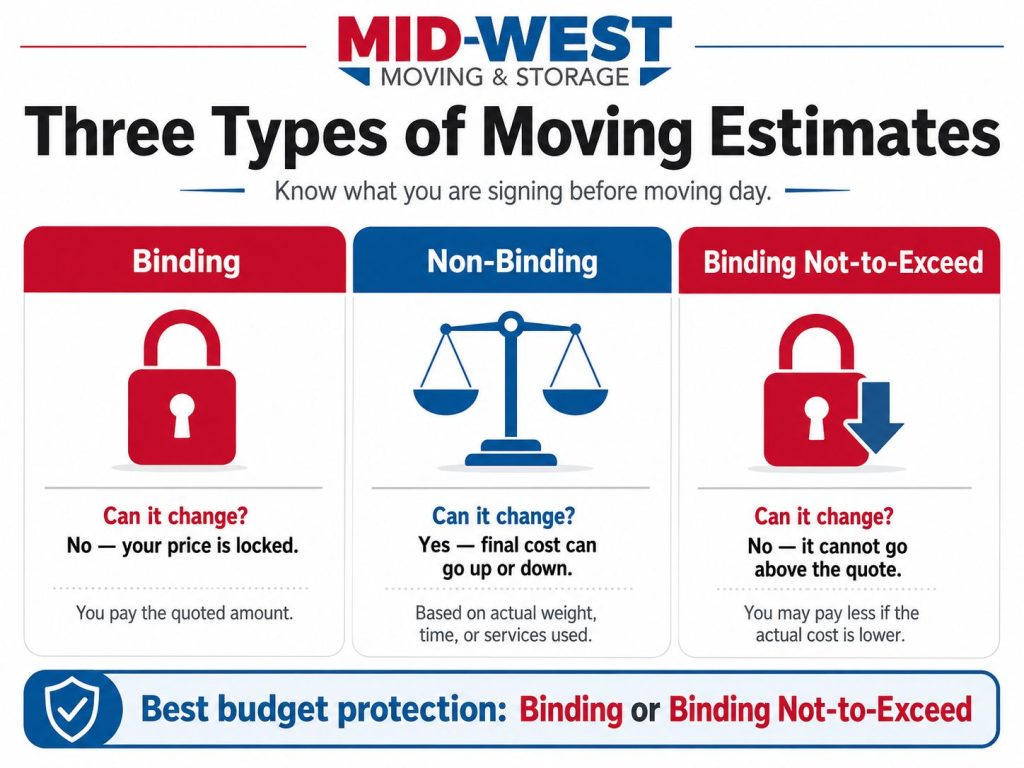
Binding vs. Non-Binding vs. Not-to-Exceed: Comparison Table
| Feature | Binding | Non-Binding | Binding Not-to-Exceed |
|---|---|---|---|
| Final price locked? | Yes | No | Yes (or lower) |
| Can you be charged more? | No | Yes, up to 110% at delivery | No |
| Can you pay less than the quote? | No | Yes, if actual costs are lower | Yes |
| Best for budget control? | Yes | No | Yes |
| Common for local moves? | Sometimes | Often | Less common |
Which type of moving estimate is better?
For most moves, a binding or binding not-to-exceed estimate is the better choice. You know your maximum cost before the truck is loaded, and there are no surprises on delivery day. The binding not-to-exceed estimate is the best of the three because it protects your ceiling while still letting you benefit if the move costs less than expected.
That said, a non-binding estimate can work fine for a simple local move where pricing is straightforward: a small apartment, an hourly rate, a short drive. In those cases, the actual cost usually lands close to the estimate. The risk grows with the size and distance of the move, which is why long-distance customers in particular should push for a binding or not-to-exceed agreement.
Whichever type you choose, get it in writing, and keep it with your moving checklist for reference on move day. A verbal quote is not an estimate at all.
What does federal law say about moving estimates?
For interstate moves, the FMCSA sets clear rules that many customers do not know about:
- Movers must provide a written estimate before the move. Interstate movers are also required to give you the FMCSA’s “Your Rights and Responsibilities When You Move” booklet.
- With a binding estimate, the mover must honor the quoted price for the agreed scope of work.
- With a non-binding estimate, the mover cannot require more than 110% of the estimated amount at delivery. Once you pay that 110%, the mover is legally required to release your shipment. Any remaining balance is billed later, with payment generally due within 30 days.
- A mover cannot hold your belongings hostage to demand payment beyond these limits.
Local moves within Illinois are regulated separately by the Illinois Commerce Commission, which requires licensed movers to provide written estimates as well. Mid-West Moving & Storage is fully licensed for both (U.S. DOT #294025, ILL. C.C. 75043).
Red Flags to Watch for When Getting a Moving Estimate
The estimate process itself tells you a lot about a moving company. Watch out for these signs, and see our full guide to moving scams to avoid in Chicago for more:
- Movers who refuse to give a binding estimate: A company that will not commit to a price in writing for a well-documented inventory is a company planning to bill you for overages.
- Phone-only estimates with no survey: No mover can accurately price your move without seeing your home in person, over video, or through a detailed inventory. A quote based on “about how many rooms do you have?” is a guess.
- No written estimate at all: Verbal quotes are unenforceable. Every legitimate estimate should be in writing with the estimate type clearly labeled.
- Estimates that seem too good to be true: A lowball number is a classic tactic: win the job with a cheap quote, then inflate the bill once your belongings are on the truck. Compare quotes from multiple companies and be suspicious of any that come in dramatically below the rest.
Get an Accurate, Honest Moving Estimate in Chicago
Mid-West Moving & Storage has been moving Chicagoland families and businesses since 1983, and we put every estimate in writing: no phone-only guesses, no surprise charges at delivery. Choose an in-home walkthrough, a live video survey with one of our senior relocation managers, or a DIY video survey through our app, and get a free, no-obligation quote for your move.
Explore our full range of residential, long-distance, and commercial moving services or call us at (847) 593-7201 to schedule your free estimate.
Moving Estimates FAQs
Can a binding estimate change?
Only if the scope of the move changes. If you add items that were not on the original inventory or request extra services like packing or storage, the mover can prepare a revised binding estimate before performing the additional work. For the original inventory and services, the price is locked.
What happens if my stuff weighs more than the estimate?
It depends on the estimate type. With a binding or binding not-to-exceed estimate, nothing changes: you pay the quoted price. With a non-binding estimate, your final bill is based on the actual weight, so you will pay more. For interstate moves, the mover can only require 110% of the estimate at delivery, with the remainder billed afterward.
Is a non-binding estimate just a guess?
A good non-binding estimate is an informed approximation based on a survey of your belongings, not a random number. But it is not a price commitment. The final charge is calculated from actual weight or hours, so treat a non-binding estimate as a starting point rather than a ceiling.
Are moving estimates free?
Reputable movers provide free, no-obligation estimates, whether in person, by video survey, or through an inventory app. Be cautious of any company that charges a fee just to quote your move.
Do movers have to honor a binding estimate?
Yes. A binding estimate is a contract. As long as the inventory and services match what was estimated, the mover must charge the quoted amount, no more. If a mover demands extra payment at delivery for a move that matches the binding estimate, that violates federal regulations on interstate moves.
What is an order for service in moving?
An order for service is the document that authorizes the mover to transport your shipment. It lists the services to be performed, pickup and delivery dates, the estimate type and amount, and the mover’s contact information. Interstate movers are required to prepare one for every move, and you can cancel it without penalty before the move begins.

Director of Marketing & Development
Kari-Ann Ryan is a dynamic marketing strategist with a proven track record in brand development, corporate visibility, and business growth. As the Director of Marketing & Development for Mid-West Moving & Storage and Chicago Office Movers, she leads all branding, marketing, and business development initiatives, driving awareness and engagement across multiple industries.
With extensive experience in multi-brand marketing, nonprofit fundraising, event planning, and retail management, Kari-Ann brings a comprehensive and results-driven approach to her role. She is a dedicated leader in the business community, actively involved in the Schaumburg Business Association and the GOA Regional Business Association. She also serves as a Board Member for the Alzheimer’s Association Illinois Chapter, reinforcing her commitment to advocacy and philanthropy.
In addition to her corporate role, Kari-Ann is the founder of LMJ’s Lost Souls – Alzheimer’s Fund, a nonprofit organization dedicated to awareness, education, and fundraising for Alzheimer’s research and support.
She holds a Bachelor of Business Administration in Marketing from Western Michigan University and is Certified in Constant Contact Email Marketing, with expertise in social media strategy and digital engagement.